AI in Academia: The Professor Who Builds Neural Networks Says Don’t Use Them as a Shortcut
The professor working on a core problem in AI is watching in real time how it’s changing student learning.
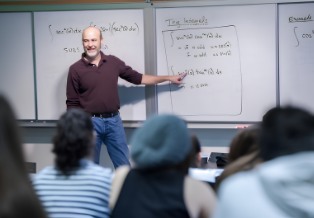
Dr. Gordon MacDonald is a professor in the School of Mathematical and Computational Sciences. He has taught at UPEI since 1993 and won the 2015Association of Atlantic Universities Distinguished Teaching Award. He also helped develop the proposal for the School to exist. His research has long focused on operator theory and linear algebra, but he describes his work in AI as theoretical.
In 2019, Dr. MacDonald and his co-authors released a paper proposing “volume-preserving” neural networks, a design aimed at the vanishing gradient problem. Ina deep neural network, the signal that tells the early layers how to adjust can shrink as it travels backward through the layers, so those layers barely learn. Dr. MacDonald’s approach is built to keep that signal balanced.
The research has not brought him any closer to being an AI evangelist. He says AI became a real issue in the classroom a couple of years ago, once it became easily accessible to students. He sees an upside, but a downside as well.
The upside is that it can act as a tutor outside of the classroom, tailoring the learning to what’s most effective for each student. The downside, however, is thatprofessors can no longer count on students completing their assignments on their own outside of class, and most professors in the School have reduced or eliminated take-home work as a result. Dr. MacDonald describes policing the technology as an impossible chase, because AI keeps getting better.
The School’s answer is a principle rather than a ban. Dr. MacDonald says most professors agree on the same standard, and it applies to AI as much as to the calculator before it: “You’re allowed to use a tool, whether it’s a calculator or AI, as long as you understand what’s being done and could do it by hand givenunlimited time.”
“Don’t use AI as a shortcut to knowledge. Use it only if it makes you more efficient.”
In practice, it means turning to AI for tasks that you already know how to do yourself. Like in a game, once you automate a process that you can do by hand, thenyou can move on to bigger things. The distinction is whether the tool is saving you time or standing in for your understanding.
Looking ahead, Dr. MacDonald does not claim to have the answers. Within the classroom, he treats AI as a tool for working more efficiently. Beyond it, thepicture starts to blur. Will AI be a bridge to knowledge, rather than a replacement?
Photo Credits: Science Atlantic / Hall of Fame